


Digital Object 1966
Description:
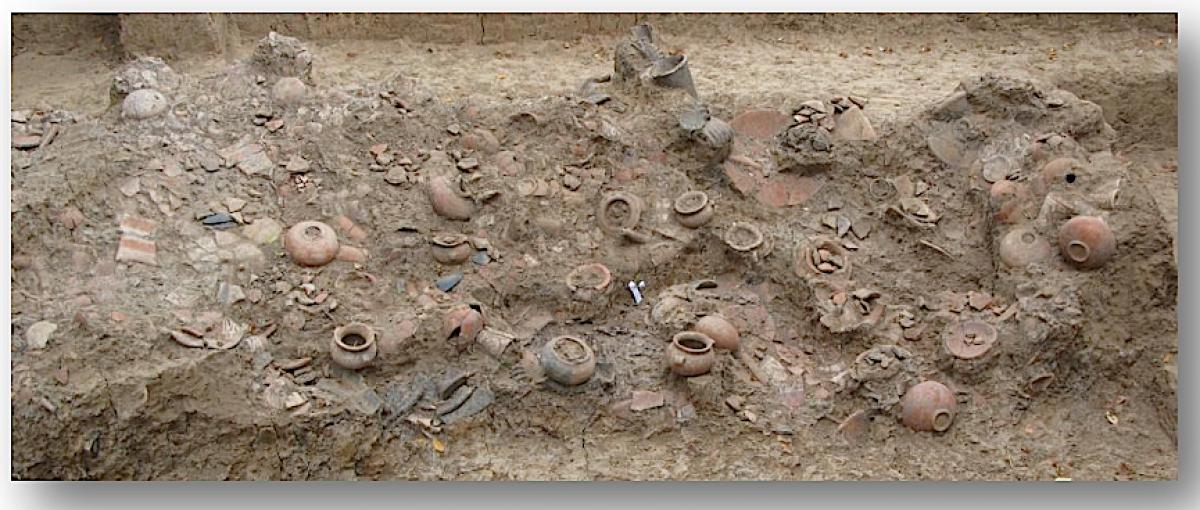
UE082. Deposit of ceramics and stone artefacts, originally quadrangular, with the corners oriented towards the four cardinal points. It was destroyed, in part, by the excavation of the grave of tomb T1, which impacted the centre and the NE and SE sectors. The NW and SW borders are preserved. It has an "L" shape. The NW edge is 2.1 m x 1.3 m. The SW edge is 2 m long. The whole unit has a dip of 45º, and runs from the edge of the feature to the midpoint of what was originally the center of the deposit.
The matrix that surrounds the artifacts is clayey, brown with reddish tones, contains fine sands and is compact. Ceramic artifacts are mostly plates, pitchers and small pots. The ceramics are superimposed in an orderly fashion. The plates were almost always placed face down, covering the articulated human remains of a series of incomplete individuals (minimum number of two). They therefore cover a primary burial (UE082b). Jars and pots were placed on top of them. Many of these artefacts, most of them, are fragmented, but keep their original geometry. It is possible that, in addition to having a religious purpose (offering to the dead), all these materials also serve to protect the physical integrity of the bodies. Multiple burial. The bodies were in a very poor state of preservation. We know that they were articulated, belonging to adult individuals buried with their heads towards the NW. They were found under the UE082a unit many times attached to plates and trays. They were cut by the excavation of the grave of tomb T1.
UE082c. Cutting of the pit. It is only partially preserved because it was cut by the grave in tomb T1. Originally it probably had a quadrangular shape and dimensions of 2 m x 1.5 m. An L-shaped portion of it has been preserved. Its corners are oriented towards the four cardinal points. It is the fossa of tomb T2.
The matrix that surrounds the artifacts is clayey, brown with reddish tones, contains fine sands and is compact. Ceramic artifacts are mostly plates, pitchers and small pots. The ceramics are superimposed in an orderly fashion. The plates were almost always placed face down, covering the articulated human remains of a series of incomplete individuals (minimum number of two). They therefore cover a primary burial (UE082b). Jars and pots were placed on top of them. Many of these artefacts, most of them, are fragmented, but keep their original geometry. It is possible that, in addition to having a religious purpose (offering to the dead), all these materials also serve to protect the physical integrity of the bodies. Multiple burial. The bodies were in a very poor state of preservation. We know that they were articulated, belonging to adult individuals buried with their heads towards the NW. They were found under the UE082a unit many times attached to plates and trays. They were cut by the excavation of the grave of tomb T1.
UE082c. Cutting of the pit. It is only partially preserved because it was cut by the grave in tomb T1. Originally it probably had a quadrangular shape and dimensions of 2 m x 1.5 m. An L-shaped portion of it has been preserved. Its corners are oriented towards the four cardinal points. It is the fossa of tomb T2.
Excavation campaign:
2009-2010
Record type:
Stratigraphic unit register
Context-based browsing of El Caño repository
Archaeological site:
El Caño
Operation:
Operation 1
Stratigraphic group:
Tomb 5
Stratigraphic unit type:
Interment
Stratigraphic unit (characteristics):
082
Calibrated Age Range:
Cal AD 780 to 900 (Cal BP 1170 to 1050)/Cal AD 920 to 960 (Cal BP 1040 to 990)
Digital Object 1966