


Digital Object 1996
Description:
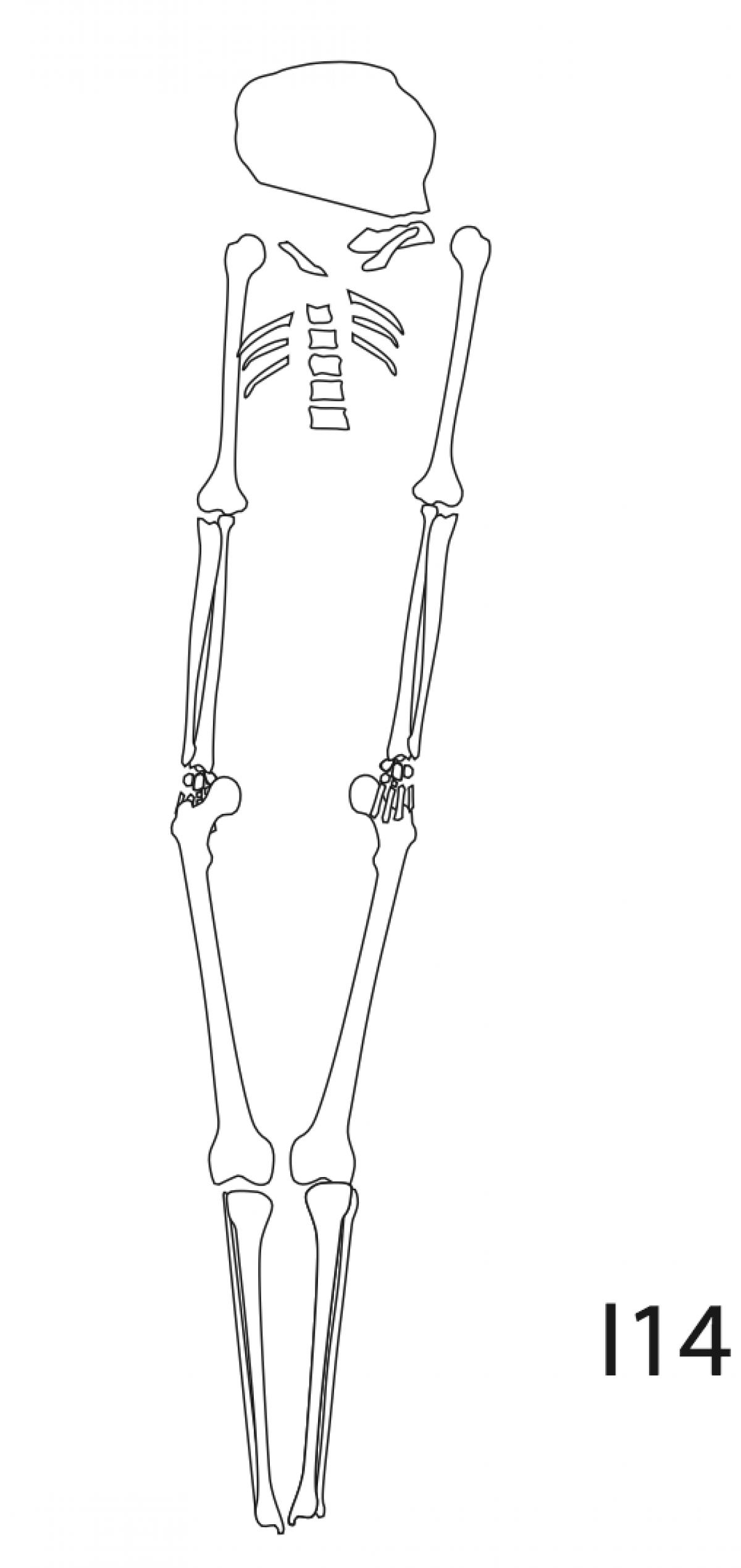
T2-I14. Adult male, between 25-30 years old, according to the relationship between occlusal wear and age. He had a callus on the distal third of his left ulna as a result of a fracture sustained at some point in his life. No degenerative processes were identified.
The individual had a robust build with a marked linea aspera on the femurs. Height could not be estimated because no long bones could be measured. However, the length of the skeleton was 157 cm (head-foot).
br> The individual was lying in a prone position with the face resting on the right side. The upper limbs were laid out extended and parallel to the body, with the hands in a lateral position. The lower extremities were extended and were not rotated.
This individual was one of the best preserved. It was observed that they were tilted on the left side since under the right side was individual I18, leaving this area in a higher plane of excavation. As a consequence of this, during the decomposition there were empty microspaces in the thorax area that caused the sinking of ribs and vertebrae. However, the joints of the upper limbs, as well as the knees, were in a strict anatomical position, indicating that the decomposition took place in a densely packed space and that these slight movements were the result of the empty spaces remaining between the bodies.
On the other hand, there was strong compression of the shoulders, which caused both clavicles to be positioned at a 90-degree angle between them at the midline. The knees and feet were also found to be in contact, suggesting that the bodies were tightly bound or bundled. Individual I14 was deposited with the head facing SE, directly under individual I15 and over individual I18.
The individual had a robust build with a marked linea aspera on the femurs. Height could not be estimated because no long bones could be measured. However, the length of the skeleton was 157 cm (head-foot).
br> The individual was lying in a prone position with the face resting on the right side. The upper limbs were laid out extended and parallel to the body, with the hands in a lateral position. The lower extremities were extended and were not rotated.
This individual was one of the best preserved. It was observed that they were tilted on the left side since under the right side was individual I18, leaving this area in a higher plane of excavation. As a consequence of this, during the decomposition there were empty microspaces in the thorax area that caused the sinking of ribs and vertebrae. However, the joints of the upper limbs, as well as the knees, were in a strict anatomical position, indicating that the decomposition took place in a densely packed space and that these slight movements were the result of the empty spaces remaining between the bodies.
On the other hand, there was strong compression of the shoulders, which caused both clavicles to be positioned at a 90-degree angle between them at the midline. The knees and feet were also found to be in contact, suggesting that the bodies were tightly bound or bundled. Individual I14 was deposited with the head facing SE, directly under individual I15 and over individual I18.
Excavation campaign:
2013
Record type:
Individuals (skeletons)
Context-based browsing of El Caño repository
Archaeological site:
El Caño
Operation:
Operation 1
Stratigraphic group:
Tomb 2
Stratigraphic unit type:
Interment
Stratigraphic unit (finds):
134
Individual´s forensic data:
I14
Calibrated Age Range:
Cal AD 900 to 1020 (Cal BP 1050 to 930)
Finds-based browsing of El Caño repository
Human bone remains
Location: Tomb and Stratigraphic Unit (UE):
T2-UE134
Forensic information:
Forensic record
Identification: Sex ( / age):
Male
Age:
25 to 30 years old
Digital Object 1996