/
Search for Objects Show all
Digital Object 1077
Description:
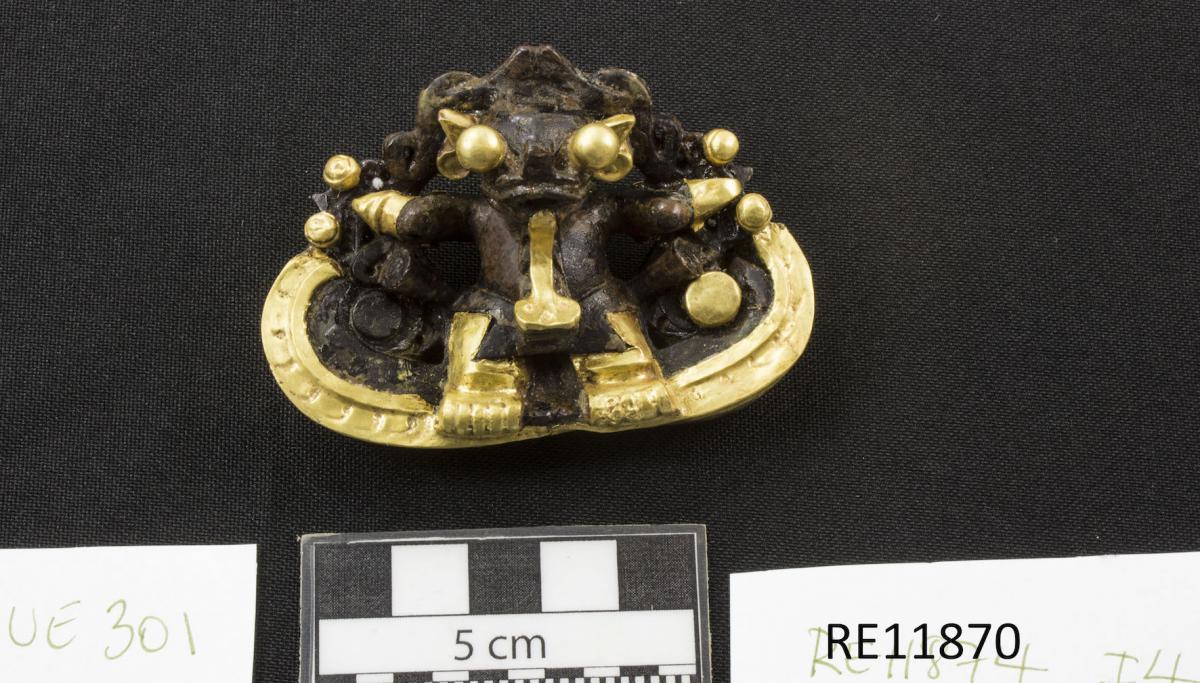
Resin figure with some elements encased in gold. It represents a supernatural being in the form of an anthropomorphic fisherman bat standing, limbs open, holding two sharks with its hands. Late Conte style.
The body and attitude of the figure are what give it its anthropomorphic character. With legs slightly open and flexed, and arms wide open at shoulder level, the hands grasp the fish at the base of one of their pectoral fins. It wears a belt from which hang, at the front, a trapezoidal skirt that reaches the knees, and at the back two wide bands fringed with curved triangles, which fall to the feet and curl towards the sides of the body over a cylindrical object, reaching the height of the hands. Two truncated conical objects that are projected obliquely forward are inserted at the starting point of these.
The head is that of a fantastic animal with the biological basis of a bat: flat nose curved upwards; eyes protruding from their orbits and projecting forward; triangular ears with a marked round tragus (possibly an ear rod); large mouth with rounded corners; upper jaw protruding from the lower jaw; triangular teeth with prominent canines; lips thickened and with an apparent transverse cut (cleft lip) through which falls a long tongue fringed with six curved triangular motifs, and which also forks at its end. The upper part of the head may have deteriorated and some elements of the headdress are missing, but two remain intact and have the appearance of little horns with a line carved in a spiral. These are attached to the skull and directed backwards. There are also two crests, which have four curved triangular motifs (feathers?), that come out of the back of the head and go down to the height of the shoulders.
The twisted bodies of the fish, symmetrical with respect to the figure that grasps them, join their tails at the top rear of the head. They have pointed triangular heads, globular eyes, and large mouths with triangular teeth. The torsion of the animals leaves five fins visible on each, the caudal, two above, and two below.
MG
Conservation treatment:
 
This figure arrived at the laboratory covered with a large amount of sediments. These partially covered both sides. It was also partially damp. It seemed to be in one piece, something that could be corroborated after removing the sediments that covered it. Firstly, bamboo skewers were used to remove the soil on both sides. This process was carried out meticulously using the stereoscope as a guide for better viewing, thus avoiding scratches. Next, some gold sleeves were carefully removed, which were later cleaned separately. For this, bamboo sticks were used with cotton lightly impregnated with a solution of ethanol and demineralized water (50:50). The inner parts of the gold covers were reinforced with Japanese paper. Many of these small pieces of gold had small cracks, and Japanese paper helped create support bridges. Paraloid B-72 was used at low percentages (6%) to adhere the Japanese paper to the inner walls of the gold covers. These were then numbered and allowed to dry as work continued on the micro-excavation of the resin object. As it was important to handle it while still humid, demineralized water was sporadically applied with a water spray. When the object dried, dry bamboo skewers were used to remove the sediment. In the most difficult places smaller instruments were used, always avoiding direct contact with the surface of the piece. When the object was completely free of sediments, it was cleaned once again with cotton sticks lightly moistened in a solution of ethanol and demineralized water. The gold casings were then reinserted into their corresponding places using 40% Paraloid B-72. The resin had no cracks, so these areas were cleaned only.
Conserved by: Ileana Olmos
March, 2015
Date of field recording:
 
22/02/2015
Excavation campaign:
 
2015
Record type:
 
Resin artifacts
Context-based browsing of El Caño repository
Archaeological site:
 
El Caño
Operation:
 
Operation 1
Stratigraphic group:
 
Tomb 7
Stratigraphic unit type:
 
Interment
Stratigraphic unit (finds):
 
301
Individual´s funerary attire:
 
I04
Calibrated Age Range:
 
Cal AD 770 to 905 (Cal BP 1180 to 1045)/Cal AD 920 to 965 (Cal BP 1030 to 985)
Finds-based browsing of El Caño repository
Artifacts
Resin artifacts:
 
Pendant
Measurements
Dimension 1:
 
height mm
=:
 
51
Dimension 2:
 
width mm
=:
 
74
Dimension 3:
 
depth mm
=:
 
38
Weight:
 
g
=:
 
32.7
Digital Object 1077
/
"Except where otherwise noted, content on this site is licensed under a Creative Commons Attribution-NonCommercial-ShareAlike 4.0. International license."